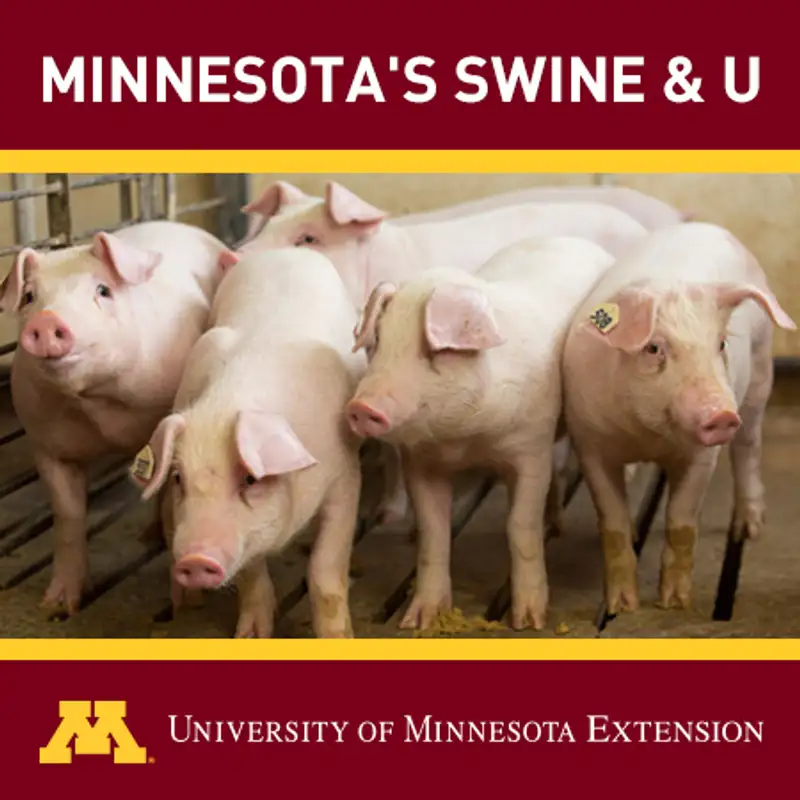
Episode 26: Effect of supplemental water source on growth and performance of grow-finish pigs.
Hello and welcome to the University of Minnesota Swine and U podcast series. Today's podcast is another research update. My name is Sarah Schieck Boelke, and I'm a Swine Extension Educator with the University of Minnesota. Joining me today is Kelsey Hammers, who is pursuing her PhD in the Department of Animal Science at the University of Minnesota. To get us started today, Kelsey, will you tell us about yourself, including who you're working with as an advisor at the university?
Kelsey Hammers:Sure. Thanks, Sarah, for having me today. And as you mentioned, my name is Kelsey Hammers and I grew up on a cow calf and row crop farm in North Central Missouri. I attended the University of Missouri where I obtained my bachelor's degree in animal science in 2018. I then worked on my master's degree in swine nutrition at Kansas State University, where I graduated in July 2020.
Kelsey Hammers:And currently I am pursuing my PhD under Doctor. Lee Johnston here at Minnesota.
Sarah Schieck Boelke:Thank you. I always find it interesting the path that students take, whether it be undergrad and then to graduate school. So very interesting and thank you for sharing that. So with that, let's get into the research that you're gonna be talking about today. Can you tell us, yeah, what research topic will you be sharing with us today?
Kelsey Hammers:Sure, so today I'd like to talk about a study looking at the effect of a supplemental water source on the performance of growing and finishing pigs.
Sarah Schieck Boelke:And before we get too far here, we probably should give some mention to the funding source as all research doesn't happen unless there is a funding source for that research. So can you share how was this research funded?
Kelsey Hammers:Sure, so this study was a little bit different for university. Basically that the study was conducted and funded by Ideal Animal Nutrition and, Boar Broom Ag Services of Tracy in Marshall, Minnesota. So, and to give the listeners a bit more context, Doctor. Johnson and I were only involved during the statistical analysis, the data that was generated from the trials.
Sarah Schieck Boelke:Great, thank you for that explanation. So now, are you able to give us a brief introduction to this research study? For example, explaining why it was a valuable project to do.
Kelsey Hammers:Wet dry feeders are a popular feeder type for finishing pigs, and this is usually because feed and water wastage are reduced while these pigs typically experience increased average daily gain and feed intake. It's recommended to stock 13 pigs per feeder space for a wetdry feeder and for a water source to provide at least four cups a minute. But this feeder type is relatively new to the marketplace and is a common feeder choice in new barn constructions in recent years. Therefore, the investment in this feeder type needs to be optimized as management practices used for conventional dry feeders may differ for a wetdry feeder. So this raised the question, is the water that is normally provided in a wet dry feeder sufficient to meet the water demands throughout the growfinish phase?
Sarah Schieck Boelke:And now I know you said in this project you were mostly involved in the statistical analysis, but are you able to share kind of like how this study was completed?
Kelsey Hammers:Yeah, so in this study, there was a total of 2,332 pigs, and these pigs were used in two eighty four day growth trials that were conducted in Southwestern Minnesota from August to November 2019, and then another study from February to June 2020. There were 27 to 30 pigs in each pin and 40 replicate pins per treatment. These pigs were assigned randomly to one of two treatments based on their initial body weight. These pigs were placed either in pins with a drop shelf wetdry feeder or were placed in pins with the same feeder, but with an additional water source in the form of an adjustable double nipple water. These pigs and feeders were weighed every fourteen days to determine growth parameters of average daily gain, average daily feed intake, and feed efficiency.
Kelsey Hammers:The trials ended on day 84 as marketing events began on this day, and this is because we expected to see the biggest response when the most pigs were in the pen with the highest pressure on the feeders. Water disappearance was also measured daily across all pins in each treatment for each trial. Both trials had identical feed budgets for the six phase finishing program, and diets were corn and soybean meal based with 10% distillers. But as a reminder, the University of Minnesota was only involved in statistical analysis like you mentioned.
Sarah Schieck Boelke:Yeah, still it's good, I think for listeners to kind of have an idea of how this study happened in the barn during data collection. So thank you for giving us that explanation. So like you mentioned, you mostly were part of the data analysis. So are you able to share with us what the results were of this study?
Kelsey Hammers:Yeah, so the data from the combined trials showed that overall from day zero to day eighty four, there were no differences in average daily gain, average daily feed intake, or feed efficiency for the pigs given a supplemental water source or not. There was also no evidence for differences in body weight at day zero and day eighty four or average market weight as well. The number of pigs that were removed from the trial or that died were not different between treatments. Finally, we saw a numerical increase in water disappearance for pigs given a supplemental water source as water disappearance ranged from five fifty four to three fifty four liters per pig. But I'd like to point out again that the water disappearance wasn't measured at a pin level, and this was only a numeric difference.
Sarah Schieck Boelke:Great, thank you. So based off of those results that you just shared, what conclusions can be made from this study?
Kelsey Hammers:Well, looking from the results of this trial, there are three main aspects that come to mind that may influence future results and production decisions. First off, we observed that more water was used with a supplemental water source. Some of this water usage could be water wastage which would increase the reproduction leading to more manure that needs to be handled. Secondly, this experiment was conducted in temperate seasons. Perhaps if these trials would have been conducted in the warmest months of the year, water demand may have increased.
Kelsey Hammers:Finally, the additional water may interact with feeder space. In these experiments, feeder space was not restricted. There may have been a benefit to an additional water source if more pressure would have, if more pressure was put on the wet dry feeder.
Sarah Schieck Boelke:Thank you for sharing the results and the conclusions that you've made off of them. Now with that in mind, what are some important takeaways from this study?
Kelsey Hammers:While there were no performance differences, the study still provides valuable information to pork producers as a supplemental water source is not needed in mild temperate months or a cooler climate. Further research is needed to determine if an additional water source improves growth performance in summer months when pigs commonly experience heat stress and reduced growth. Additionally, the potential downsides of a supplemental water source by increasing water use usage or wastage should be considered as manure handling and management will increase.
Sarah Schieck Boelke:Very good, thank you for sharing all of that with us today. Is there any last comments that you would like to make before we wrap up this podcast?
Kelsey Hammers:I don't believe so. I just wanna say thank you again for having me.
Sarah Schieck Boelke:Yeah, you're certainly welcome. And thank you for your willingness to do this podcast with me and share this research that you helped analyze the data on. So once again, I would like to thank everyone for listening to the University of Minnesota Swine N. U. Podcast.
Sarah Schieck Boelke:And once again, this has been Sarah Schieck Boelke, Swine Extension Educator, along with Kelsey Hammers, Animal Science graduate student with the University of Minnesota, talking about research looking at the effect of supplemental water source on growth and performance of grow finished pigs. To further connect with the University of Minnesota Swine Extension, please visit the swine specific webpages on the University of Minnesota Extension's website at www.extension.umn.edu/swine. On those pages, you will find connections to our blog and Facebook page. To learn about research being done by our Swine Faculty in Veterinary Medicine, please visit their Swine in Minnesota blog, which can be found at www.mnswinenews.com.